
Enrollment Digital Marketing Campaigns: A Guide to Campaign Metrics That Drive Enrollment Results
Enrollment Isn’t Just Marketing—It’s Mission Critical For higher education and workforce programs enrollment is more than filling seats. Every enrollment represents an opportunity to connect someone with education, skills development, career advancement, and long-term economic mobility. Today’s prospective students don’t simply respond to flyers or traditional advertising. They research programs online, compare opportunities, watch videos, […]
Enrollment Isn’t Just Marketing—It’s Mission Critical
For higher education and workforce programs enrollment is more than filling seats. Every enrollment represents an opportunity to connect someone with education, skills development, career advancement, and long-term economic mobility.
Today’s prospective students don’t simply respond to flyers or traditional advertising. They research programs online, compare opportunities, watch videos, read reviews, and often visit a website multiple times before submitting an inquiry. That means your digital marketing must do more than generate visibility—it must guide people through a thoughtful enrollment journey.
Unfortunately, many organizations still judge success using vanity metrics like impressions, page views, or social media likes. Instead of focusing on impressions or page views alone, organizations should ask deeper questions. While these numbers provide useful context, they rarely answer the most important questions:
- Are we reaching qualified prospective students?
- Are they engaging with our message?
- Are those inquiries becoming enrollments?
- And perhaps most importantly, are our outreach efforts demonstrating measurable outcomes that support our organization’s accountability?
Understanding how digital marketing funnels work—and measuring the right campaign metrics at every stage—is what transforms marketing from an expense into a strategic enrollment investment.
Why Campaign Metrics Matter for Higher Education & Workforce Marketing
Unlike retail marketing, education and workforce organizations operate in an environment where funding, compliance, and measurable outcomes are closely connected. This makes campaign measurement much more than a marketing best practice—it becomes part of responsible program management.
Organizations that invest in enrollment and outreach campaigns need to demonstrate measurable results and responsible use of their marketing budgets. For workforce organizations, this often aligns with WIOA accountability requirements, while educational institutions rely on similar performance metrics to evaluate recruitment efforts. In both cases, clearly defined Key Performance Indicators (KPIs), measurable outcomes, and documented results help demonstrate how marketing activities contribute to enrollment goals.
When marketing teams understand which metrics matter, they can make smarter decisions about budget allocation, improve enrollment performance, demonstrate return on investment to leadership, support funding and grant reporting, and better align outreach efforts with compliance expectations.
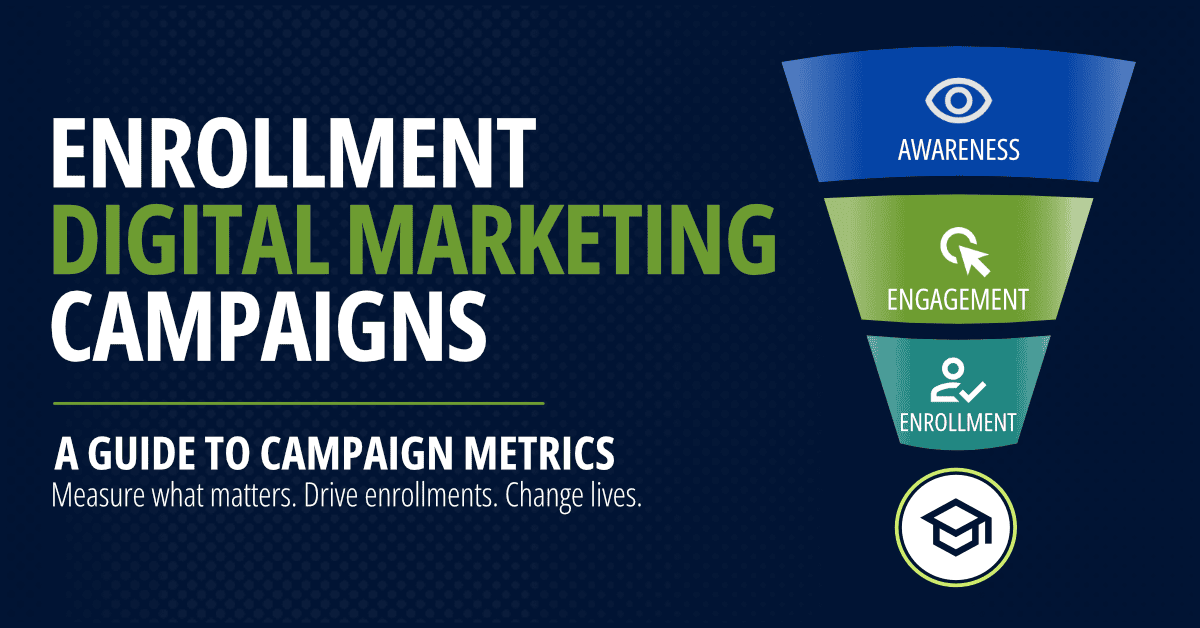
Understanding the Enrollment Funnel
Every successful enrollment campaign follows a journey. Prospective students rarely discover a program and immediately enroll. Instead, they move through several stages before taking action.
Understanding this enrollment funnel helps determine which metrics matter most at each phase.
Stage 1: Awareness
At the top of the funnel, your objective is simple:
Help the right audience discover your program.
Awareness campaigns are commonly used to introduce new workforce initiatives, Career Technical Education (CTE) programs, adult education opportunities, apprenticeships, or community services. At this stage, success is measured by how effectively your message reaches the right audience rather than by immediate inquiries.
Key metrics include:
- Reach
- Impressions
- Video Views
- Brand Recall
These campaigns focus on visibility rather than immediate conversions.
Stage 2: Traffic
Once awareness is established, the goal shifts toward driving interested users to learn more.
This might include visits to:
- Program landing pages
- Career pathway information
- Event registration pages
- Financial aid resources
- Workforce service directories
Key metrics include:
- Click-Through Rate (CTR)
- Link Clicks
- Cost Per Click (CPC)
- Landing Page Visits
These metrics indicate whether your messaging resonates enough for users to continue their journey.
Stage 3: Enrollment & Lead Generation
This is where marketing becomes enrollment.
Rather than simply generating website traffic, your campaigns encourage prospective students to complete meaningful actions such as:
- Requesting information
- Scheduling an advising appointment
- Completing an intake form
- Registering for an information session
- Beginning an application
These actions become qualified enrollment leads.
The Ultimate Enrollment Marketing Metrics Dashboard
Not every metric deserves equal attention.
The most successful enrollment teams monitor metrics based on where prospects are within the funnel.
Top-of-Funnel Metrics (Brand Awareness)
Impressions
The total number of times your advertisements appear.
A high number of impressions indicates your campaigns are successfully distributing your message.
Reach
Reach measures the number of unique individuals exposed to your campaign.
This helps determine whether you’re effectively reaching your intended audience.
Video View Rate
Video storytelling is especially effective for workforce and education marketing.
Student testimonials, employer partnerships, graduation celebrations, and career success stories help build emotional trust before someone is ready to inquire.
A strong video completion rate often signals compelling messaging.
Middle-of-Funnel Metrics (Engagement & Intent)
Click-Through Rate (CTR)
CTR measures the percentage of people who clicked after seeing your advertisement.
A strong CTR usually indicates:
- Relevant messaging
- Effective creative
- Strong calls to action
- Audience alignment
If impressions are high but CTR remains low, your message may need refinement.
Cost Per Click (CPC)
CPC measures how efficiently your advertising budget generates website visitors.
Lower CPC isn’t always better.
Qualified traffic matters far more than inexpensive clicks that never convert.
Landing Page Engagement
Once visitors arrive, monitor:
- Time on page
- Scroll depth
- Form interactions
- Bounce rate
These metrics reveal whether users are finding the information they expected after clicking your ad.
Bottom-of-Funnel Metrics (The Enrollment Bullseye)
Conversion Rate (CVR)
Conversion Rate measures the percentage of visitors who complete a desired action.
Examples include:
- Information requests
- Intake forms
- Program inquiries
- Application starts
Improving your landing page can significantly increase conversions without increasing advertising spend.
Cost Per Lead (CPL)
CPL calculates how much your organization spends to generate one qualified prospective student.
Monitoring CPL helps optimize:
- Audience targeting
- Creative messaging
- Budget allocation
- Campaign efficiency
Application-to-Enrollment Yield
Perhaps the most important metric of all is how many marketing-generated leads ultimately enroll.
This metric answers the question leadership cares about most:
Did marketing produce actual students?
Tracking this information helps calculate true return on investment and supports future funding decisions.
Improve Results Through Landing Page Optimization
Even the best advertising campaign can fail if visitors arrive at a confusing or outdated landing page.
A high-converting landing page clearly communicates the value of your program, highlights career outcomes and student success stories, loads quickly on mobile devices, and makes it easy for visitors to complete a simple inquiry form. Strong calls to action and answers to common questions further reduce friction and encourage prospective students to take the next step.
Organizations should also perform A/B testing, a process of comparing two versions of a webpage, advertisement, or call-to-action to determine which produces better results.
Small improvements—such as changing a headline, shortening a form, or using different imagery—can produce meaningful increases in conversion rates over time.
Data-Driven Marketing Builds Stronger Programs
Digital marketing isn’t about collecting clicks.
It’s about connecting the right people with life-changing educational and training opportunities.
When organizations understand which metrics matter at each stage of the enrollment funnel, they can make smarter decisions, improve campaign performance, demonstrate accountability, and better support students throughout their enrollment journey.
For workforce boards, adult education providers, community colleges, and CTE programs, this data-driven approach also strengthens compliance with funder’s expectations while maximizing the impact of every outreach dollar invested.
Marketing becomes more than promotion.
It becomes measurable workforce development.
Particular Nuances in Lead Generation Strategies
Generating leads for higher education and workforce programs among adult learners is particularly nuanced.
Adult learners often balance full-time jobs, childcare responsibilities, transportation challenges, financial concerns, and the uncertainty of returning to school. These realities make their decision-making process very different from that of a typical online shopper, requiring more trust and reassurance before they’re ready to inquire.
Because of these realities, prospective students often require more trust-building before they’re ready to submit an inquiry.
Successful enrollment marketing emphasizes:
- Student success stories
- Career outcomes
- Clear wage opportunities
- Flexible scheduling
- Financial support
- Personalized guidance
Every lead form represents more than contact information.
It represents readiness.
This is also why lead nurturing is so important. Many prospective students need multiple touchpoints—including emails, text messages, remarketing ads, webinars, and advisor outreach—before they’re prepared to enroll.
Ready to Build an Enrollment Campaign That Performs?
If your organization is investing in digital outreach but isn’t sure whether your campaigns are delivering measurable enrollment results, now is the time to take a data-driven approach.
At Full Capacity Marketing, we specialize in helping workforce boards, community colleges, adult education providers, and workforce organizations design compliant, high-performing enrollment campaigns that connect with the right audiences and generate measurable outcomes.
Whether you’re launching a new program, improving inquiry quality, or aligning marketing with funding requirements, our team can help you build campaigns that drive both enrollment and impact.
Contact Full Capacity Marketing today to create an enrollment marketing strategy that turns data into meaningful student success.
Share this article

Beyond Demographics: How Psychographics Drive Workforce & Education Engagement
Go deeper than demographics—use psychographics to connect emotionally, overcome barriers, and inspire meaningful engagement with your audiences.

Does Your Organization Have an AI Mindset? One Workforce Executive Director Weighs In
For workforce development & education organizations, the rise of artificial intelligence poses a complex challenge: conflicting perspectives between employers who want AI-ready workers and job seekers who might be anxious about AI replacing them. Learn how one workforce executive director created an AI sector strategy.

2026 Workforce & Education Marketing Trends: The Multi-Touchpoint Conversion Journey
In education and workforce development, we aren’t simply promoting a product; we are asking individuals to make a significant and life-changing decision. For the hardest-to-reach learners, this choice now takes an average of 30 touchpoints before they decide to enroll. Explore the four essential strategic shifts needed for the coming year.
Thought Leaders in Workforce, Education & Entrepreneurship
Comments
There are no comments yet