Author: fcmblog

Understanding Brand Sentiment Analysis: A Game-Changer for Organizations, Brands, and Entrepreneurs
At the start of Q3 2023, 64.5% of the world’s population were using the internet – a total of 5.19 billion people! According to DataReportal, 94% of internet users also use social media every month (Digital Around the World — DataReportal – Global Digital Insights). In today’s hyper connected digital landscape, brand sentiment analysis has […]
At the start of Q3 2023, 64.5% of the world’s population were using the internet – a total of 5.19 billion people! According to DataReportal, 94% of internet users also use social media every month (Digital Around the World — DataReportal – Global Digital Insights). In today’s hyper connected digital landscape, brand sentiment analysis has emerged as a powerful tool that can make or break a company’s reputation and success and help a brand stand out from a connected – yet crowded- market.
It’s no secret that the perception of a brand significantly impacts consumer behavior. One study found that brands with a strong and positive perception outperform those with a weak or negative one by 20%. Additionally, according to a report by Deloitte, customers are willing to pay up to a 16% price premium for products from brands they trust (https://kadence.com/the-role-of-brand-perception-in-product-marketing).
Harnessing the power of sentiment analysis can help navigate this intricate landscape effectively. In this blog post, we will explore what brand sentiment analysis is and why it’s crucial for profit, nonprofit and public sector organizations, brands, and entrepreneurs.
What is Brand Sentiment Analysis?
Brand sentiment analysis is a process that involves the evaluation of public sentiment, emotions, and opinions associated with a particular brand, product, or service. It employs natural language processing (NLP) and machine learning techniques to analyze vast amounts of textual data from various sources, such as social media, reviews, blogs, forums, and news articles.
The primary goal of brand sentiment analysis is to gain insights into how consumers perceive a brand, whether their sentiments are positive, negative, or neutral, and why they feel that way. This analysis typically assigns a sentiment score or sentiment polarity to each piece of content, helping businesses gauge overall brand sentiment and identify key areas for improvement.
Why is Brand Sentiment Analysis Important?
There are several ways in which a Brand Sentiment Analysis can help clearly define how an organization is showing up in the market, particularly when compared to competitors.
1. Customer Insights: Understanding what customers think about your brand is invaluable. Sentiment analysis helps organizations tap into the voice of the customer, uncovering valuable insights into their preferences, pain points, and expectations. By gaining a deeper understanding of consumer sentiments, organizations can refine their strategies and offerings to better meet customer needs.
2. Reputation Management: A strong and positive brand sentiment can enhance reputation, trust, and loyalty. Conversely, negative sentiment can tarnish a brand’s image and lead to customer churn, negative stories and bad reviews. With sentiment analysis, organizations can proactively manage their reputation by addressing issues as they arise and capitalizing on positive sentiment to reinforce brand loyalty.
3. Competitive Analysis: Brand sentiment analysis is not limited to your own brand. It can also provide insights into how consumers perceive your competitors. By benchmarking your sentiment against that of your competitors, you can identify gaps in the market and develop strategies to differentiate your brand effectively.
4. Product or Service Development: Sentiment analysis can guide product or service development efforts by uncovering pain points or areas where customers are dissatisfied. This data-driven approach enables organizations to prioritize enhancements in their offerings and operational strategies that align with customer expectations.
5. Marketing Campaigns: Crafting compelling marketing campaigns that resonate with the target audience is vital for brand success. Sentiment analysis can help organizations fine-tune their messaging and marketing strategies by identifying the language, topics, and themes that resonate most with their audience.
6. Crisis Management: In the age of social media, negative sentiment can escalate rapidly and damage a brand’s reputation. Sentiment analysis can provide early warning signs, allowing organizations to address issues promptly and mitigate potential crises.
7. Entrepreneurial Advantage: For entrepreneurs and startups, brand sentiment analysis can be a cost-effective way to gauge initial reactions to a new product or service. By monitoring sentiment during the early stages, entrepreneurs can pivot and refine their offerings to meet market demands effectively.
At Full Capacity Marketing, we have found the brand sentiment process has been a game changer for our clients to aid in positioning them to their ideal customers and create new opportunities for elevated brand awareness in the general market.
In an era where consumer opinions travel at the speed of light through social media and online platforms, brand sentiment analysis is no longer a luxury but a necessity. It empowers organizations, brands, and entrepreneurs to make data-driven decisions, strengthen their reputation, and foster customer loyalty. By harnessing the power of sentiment analysis, organizations can adapt and thrive in an ever-evolving digital landscape, ensuring that their brand remains relevant, trusted, and cherished by their target audience.
Want to learn more about brand sentiment analysis? Register now for our upcoming webinar.

Share this article

Funding Cuts and Fading Relevance? Take Your Brand’s Emotional Temperature
Summer offers more than a break in programming—it’s a chance to reflect, realign, and make intentional choices about how your brand is showing up in the world. For both workforce and education organizations, brand sentiment analysis provides a meaningful way to understand public perception, identify messaging blind spots, and build trust with the audiences who matter most.

2026 Workforce & Education Marketing Trends: The Multi-Touchpoint Conversion Journey
In education and workforce development, we aren’t simply promoting a product; we are asking individuals to make a significant and life-changing decision. For the hardest-to-reach learners, this choice now takes an average of 30 touchpoints before they decide to enroll. Explore the four essential strategic shifts needed for the coming year.
Lead Generation Got You Down? Pivot to Building Brand Awareness to Boost College Enrollment Numbers
Is college worth it? That’s a question more and more people are asking themselves – and that is creating a need to rethink lead generation campaigns and take a step toward building greater brand awareness for your college.
Thought Leaders in Workforce, Education & Entrepreneurship
Getting Down to Business: Advocating for Small Businesses on Capitol Hill
FCM’s VP of Operations, Anika Jackson is a member of the Intuit Small Business Council which represents over 10 million small businesses. She recently had the privilege of participating in a visit to Capitol Hill to brief policy makers on the challenges facing small business owners and advocate for policies that support their growth and […]
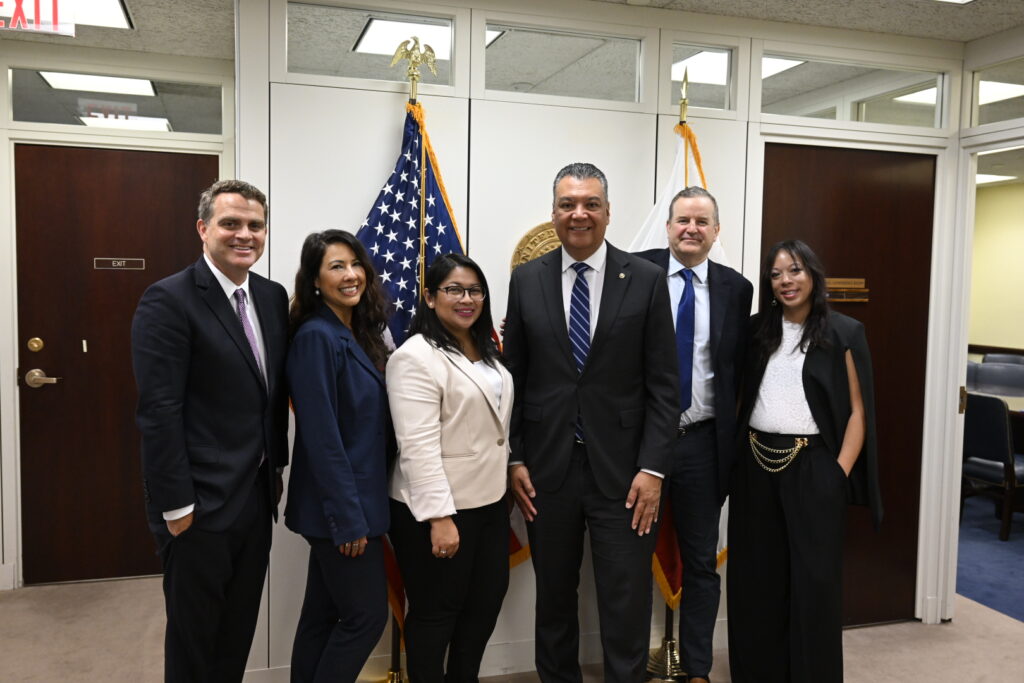
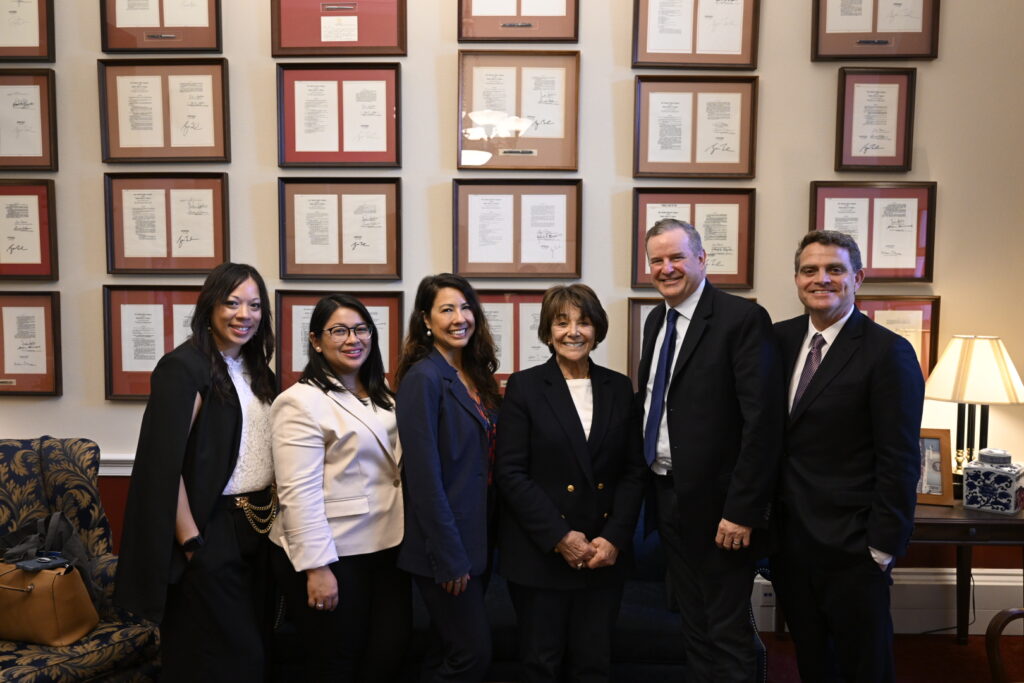
FCM’s VP of Operations, Anika Jackson is a member of the Intuit Small Business Council which represents over 10 million small businesses. She recently had the privilege of participating in a visit to Capitol Hill to brief policy makers on the challenges facing small business owners and advocate for policies that support their growth and success. Here is Anika’s account of the visit.
One of the most valuable aspects of being part of the Intuit Small Business Council is the opportunity to collaborate with diverse entrepreneurs from various industries. From tea and coffee companies to educational technology companies, manufacturers, medical and logistic companies, apparel businesses, virtual administration, bookstores, and marketing and communications companies, we have all faced similar operational challenges. Despite our different verticals, our shared experiences enable us to understand the common struggles of running a small business.
During our meet up in Washington D.C., we set three primary objectives to guide our advocacy efforts:
- Share the priorities of small businesses and self-employed individuals with key policymakers on Capitol Hill, ensuring that the voices of Intuit customers are heard.
- Advocate for policy changes to address the specific needs of small businesses.
- Foster meaningful connections and networking opportunities among council members.
Our journey began at Intuit’s DC Headquarters, where we gathered to discuss the issues each of us faced and to prepare our talking points for our Day on the Hill. What made this experience truly thrilling was the opportunity to engage with elected and appointed officials, including influential figures like Representative Roger Williams, Chairman of the House Small Business Committee, Senator Ben Cardin, Chair of the U.S. Senate Committee on Small Business & Entrepreneurship, Isabella Casillas Guzmán, the head of the Small Business Administration, and Deanne Millison, Vice President Kamala Harris’s chief economic advisor.
Our advocacy work focused on three main topics that we believe are crucial for the success of small businesses: digital adoption, access to capital, and frictionless regulations.
Digital adoption emerged as a pressing concern, especially in the wake of the COVID-19 pandemic. Small businesses had to quickly adapt and embrace digital technologies to survive. However, our policymakers and government leaders have yet to update policies and resources to support small businesses in this digital shift, leaving them at a disadvantage in both domestic and global markets.
Statistics demonstrate the strong correlation between digital adoption and small business success. Small businesses that incorporate multiple technology platforms into their operations witness growth in sales, profits, and employment. Despite the importance of digital tools, many small businesses lack the resources and guidance to make informed decisions about which solutions suit their unique needs. We urged Congress to implement legislation that modernizes the Small Business Administration (SBA) by including digital tools as an allowable use of funds, ensuring affordable access to digital technologies.
To achieve this, we proposed several policy asks, including clarifying SBA policy to support digitization tools, establishing an educational program to promote awareness of digital tools, and conducting a study on the impact of limited access to digital tools on underserved and rural markets.
Access to capital remains a significant obstacle for small businesses. According to the Intuit QuickBooks Small Business Insights 2023 survey, a majority of small businesses rely on personal savings for funding, while securing loans from commercial lenders proves challenging. The existing capital market structure favors established firms and overlooks underserved entrepreneurs. This lack of access to capital stifles innovation and hampers the growth of small businesses.
We emphasized the importance of introducing new distribution channels and reforming existing SBA loan programs to enhance access to capital for small business owners, particularly those who have been historically underserved. This includes making microloans more accessible through traditional and nontraditional lenders, improving transparency in financing terms, and supporting the SBA’s efforts to expand its licensing capacity for non-bank lenders.
Regulations also pose a significant burden on small businesses. Compliance with complex federal, state, and local regulations drains entrepreneurs’ time, money, and energy, diverting their focus from business growth. We urged policymakers to streamline the regulatory landscape and reduce the barriers to starting a business, ensuring that entrepreneurs can navigate the process efficiently and at a minimal cost.
To achieve this, we proposed directing the SBA to create a single list of all requirements to start a business, accompanied by easy-to-understand guides. Coordinated efforts across Entrepreneurial Development Programs and federal and state incentives to encourage local authorities to reduce barriers were also part of our policy asks.
In conclusion, our Day on the Hill as members of the Intuit Small Business Council was an enlightening and productive experience. We had the privilege of engaging with policymakers, sharing our perspectives, and advocating for policies that address the challenges faced by small businesses. Through our focus on digital adoption, access to capital, and frictionless regulations, we hope to drive positive change and create an environment that nurtures the growth and success of small businesses. By amplifying the voices of entrepreneurs, we can foster an ecosystem that empowers them to thrive in an ever-evolving business landscape.

Share this article
2026 Workforce & Education Marketing Trends: The Multi-Touchpoint Conversion Journey
In education and workforce development, we aren’t simply promoting a product; we are asking individuals to make a significant and life-changing decision. For the hardest-to-reach learners, this choice now takes an average of 30 touchpoints before they decide to enroll. Explore the four essential strategic shifts needed for the coming year.

Beyond Demographics: How Psychographics Drive Workforce & Education Engagement
Go deeper than demographics—use psychographics to connect emotionally, overcome barriers, and inspire meaningful engagement with your audiences.
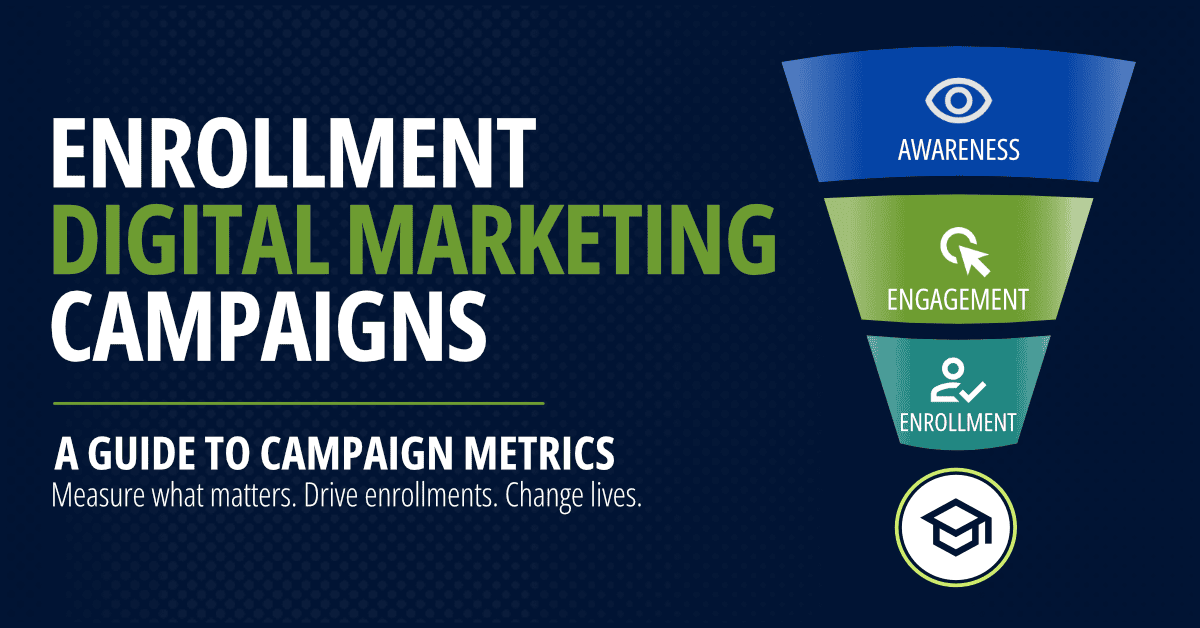
Enrollment Digital Marketing Campaigns: A Guide to Campaign Metrics That Drive Enrollment Results
Enrollment Isn’t Just Marketing—It’s Mission Critical For higher education and workforce programs enrollment is more than filling seats. Every enrollment represents an opportunity to connect someone with education, skills development, career advancement, and long-term economic mobility. Today’s prospective students don’t simply respond to flyers or traditional advertising. They research programs online, compare opportunities, watch videos, […]
Thought Leaders in Workforce, Education & Entrepreneurship
Hacienda La Puente Adult Education: A Case Study in Effective Storytelling
People love a good story. Stories create emotional connections. They make information memorable. Read on to learn why you should pause to ask: What’s my organization’s story, and how are we telling it?
People love a good story. Stories create emotional connections. They make information memorable. In fact, Mention.com shares in this article that people retain 70% of information through stories, but only 10% from data and statistics. That’s because “the brain releases dopamine into the system when it experiences an emotionally charged event, making it easier to remember and with greater accuracy.” (To better understand, check out Mention’s infographic showing how storytelling affects the brain.)
That’s a pretty strong case for pausing to ask: What’s my organization’s story, and how are we telling it?
It’s a question that leaders at Hacienda La Puente Adult Education (HLPAE) asked themselves last summer, when they came to us for help in trying to increase their visibility in the community. We were more than happy to partner with them to help them identify and shape their adult school’s story. Before you can storytell, your organization must do the work of identifying your authentic story.
Located about half an hour east of Los Angeles, HLPAE offers high-quality academic and career programs in state-of-the-art facilities. Their training programs lead to entry-level careers and eligible students can receive federal grant money to help cover the cost of the program, and yet enrollment isn’t where school leaders want it to be.
So, we headed out to their main campus, at the Willow Center in La Puente, to learn more about their work and see their programs in action.
Where do you find your story?
A number of factors go into identifying and shaping your organization’s story, but one good place to start is by taking a step back and reviewing your offerings from a student’s perspective. Or better yet, enlist the help of your students and partners to help you understand the things about your organization that most stand out.
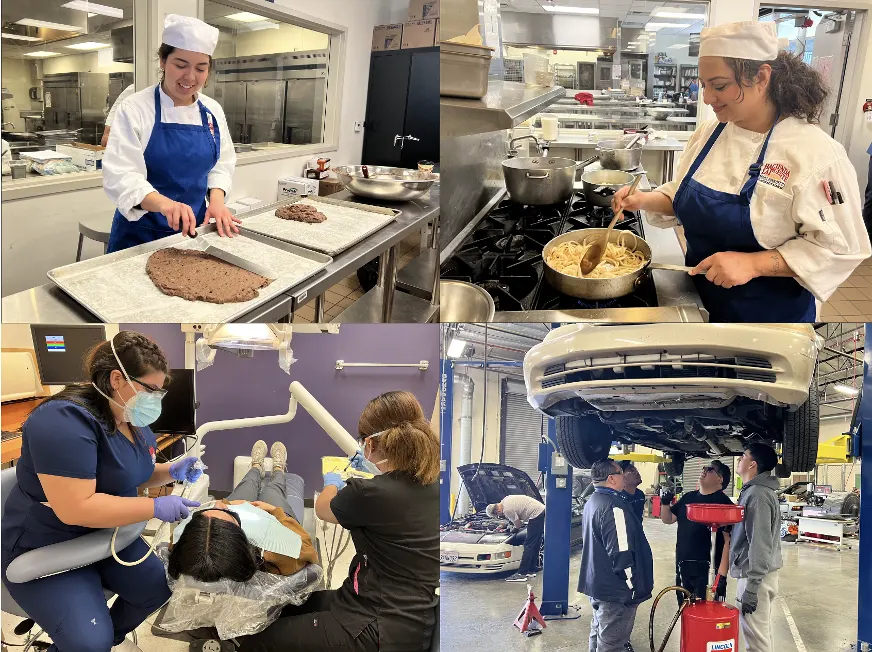
During our visit to HLPAE, we were able to see their culinary students in action, practicing their cooking and baking skills using commercial-grade tools and equipment in a state-of-the-art kitchen that is part of the Culinary Arts Academy. Students have the opportunity to gain real-world experience through an externship and get help with finding a job afterward. In less than a year, adults seeking to launch a new career can become a professional trained chef for less than $5,000 – and eligible students can receive federal Pell Grants to help cover the cost of career training.
HLPAE also offers training for trade careers, such as automotive technician, and health careers such as the nationally accredited registered dental assistant program.
In all, the school offers some 20 programs that lead to entry-level jobs or help current workers upskill. They also offer something few other adult schools do: an on-site America’s Job Center of California (AJCC), which provides resources and assistance to job seekers, helping to create a seamless transition from school to work.
Rolling Out Your Organization’s Story
In our research and during our visit, we found HLPAE had a lot to offer that would benefit the adult learners in their community. Last fall, we conducted market research and used it to develop a brand narrative, logo and tagline. We also conducted a communications audit to understand their current communications situation and where improvements could be made.
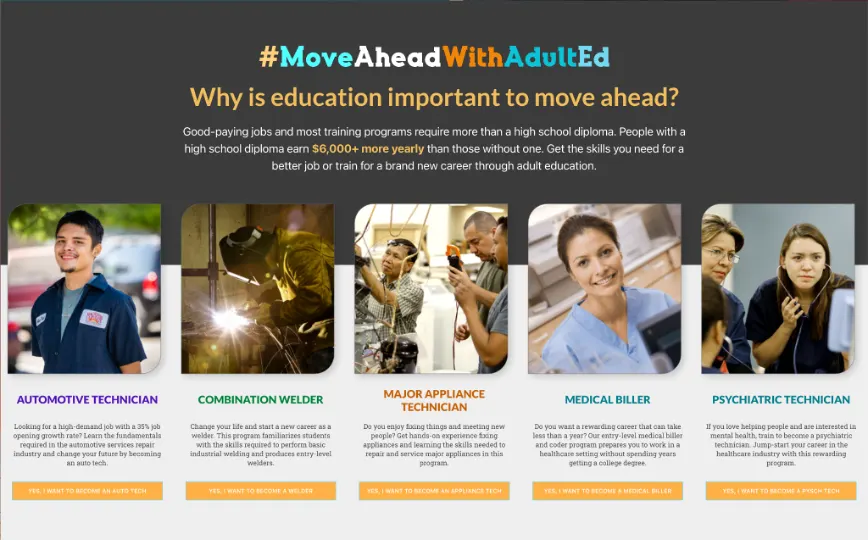
With our research completed and their story clear, we launched a landing page to recruit new students that highlights several of their career education offerings.
We’re now in the process of developing a digital campaign that focuses on their career programs to roll out their story to the right audiences.
Do you feel like you have a good story to tell but just aren’t sure where to start? We can help you identify and shape your organization’s story in an authentic way, so you can better connect with your target audiences. I’d be happy to chat with you. Just drop me a line at celina@fullcapacitymarketing.com.
Share this article
Enrollment Digital Marketing Campaigns: A Guide to Campaign Metrics That Drive Enrollment Results
Enrollment Isn’t Just Marketing—It’s Mission Critical For higher education and workforce programs enrollment is more than filling seats. Every enrollment represents an opportunity to connect someone with education, skills development, career advancement, and long-term economic mobility. Today’s prospective students don’t simply respond to flyers or traditional advertising. They research programs online, compare opportunities, watch videos, […]

Capturing Hearts Through Visual Content: How Visual Storytelling Turns Interest into Action
Case Study – Discover the power of video storytelling in workforce and education marketing. When structured thoughtfully, video does more than showcase success, it builds emotional connection, reinforces credibility, and drives action.
Lead Generation Got You Down? Pivot to Building Brand Awareness to Boost College Enrollment Numbers
Is college worth it? That’s a question more and more people are asking themselves – and that is creating a need to rethink lead generation campaigns and take a step toward building greater brand awareness for your college.
Thought Leaders in Workforce, Education & Entrepreneurship
Lead Generation Got You Down? Pivot to Building Brand Awareness to Boost College Enrollment Numbers
Is college worth it? That’s a question more and more people are asking themselves – and that is creating a need to rethink lead generation campaigns and take a step toward building greater brand awareness for your college.
Is college worth it? That’s a question more and more people are asking themselves – and that is creating a need to rethink lead generation campaigns and take a step toward building greater brand awareness for your college.
It used to be that college was perceived as the best path to a good future. But perceptions of higher education have been changing for some time now and inflation, coupled with the rising cost of tuition, are just some of the latest factors impacting enrollment, as covered last fall in this NBC News story, “Growing Number of Americans Questioning the Value of College Degree.”
The Hechinger Report’s “How higher education lost its shine,” published around the same time, shares that “Americans are increasingly dubious about the need to go to college. Fewer than one in three adults now say a degree is worth the cost, according to a survey by the Strada Education Network.”
The article goes on to explain that some of the reasons for this, as gleaned from focus groups and public opinion surveys, is widespread and fast-growing skepticism about the value of a degree, impatience with the time it takes to get one and costs that have finally exceeded many people’s ability or willingness to pay.
Add to those perceptions the fact that other educational options are increasingly available. This Inside Higher Education story covers the findings of a study on higher education enrollment declines and touches on some of those options.
“The respondents were also taking advantage of, and saw value in, alternative modes of education outside of pursuing a degree, according to the study,” the article reads. “Almost half of the group, 47 percent, reported they had taken or were currently taking classes on YouTube. Roughly a quarter of respondents had participated in courses to receive a license, and 22 percent participated in classes to earn a verified certificate.”
The factors converge to make it necessary for community colleges and college programs to evolve to survive, and they must rethink their brand in the process – who are they now and what do they offer that competing educational modes don’t?
People Need to Know You Before They Can
Trust You
Digital marketing and social media are important distribution channels for building brand awareness. You might think of them primarily as vehicles for lead generation, good tools to help get users to sign up for an upcoming event or capture their information so you can send them promotional emails in the future.
Social media is a good tool for lead generation, but it is also important for building brand awareness. The Digital Marketing Institute shares that brand awareness, as opposed to pure lead generation, is becoming a greater focus on social media.
So, what is brand awareness? Brand awareness focuses on making your target audiences familiar with your brand. You are letting them know you exist and what you are about. Your audiences can then form an opinion about whether they want what you have to offer. Once they are aware of your brand, and trust it, then they are in a position to take action.
Here’s another way of describing brand awareness, courtesy of this LOCALiQ article:
“To put it in terms of another analogy, brand awareness helps you grease the wheels when it comes to getting new customers. When a person is already familiar with your business, they’re more likely to click on your ads, give you their information, or become a customer. In fact, one study found that when searching for a business, 82% of people clicked on a result from a brand they were familiar with.”
This Wordstream by LOCALiQ article provides some good tips and examples of brand awareness.
Taking the time to build this awareness is an important part of any campaign. Before you ask a prospective student to enroll or sign up for an event, you want to spend 4-6 weeks running awareness ads, so prospective students have a chance to get to know you before you ask them to take action. So don’t forget when planning for your next campaign to dedicate a portion of your budget to brand awareness.
But First, Get Clear on Your Brand
Do you know what your college’s share of voice and sentiment are, for both specific classes and the college’s reputation overall—especially against those of your competitors?
Given the shifting views about higher education and its value, before you even start planning a brand awareness campaign, it’s important to understand how your current brand is being perceived within your unique market.
You can certainly gather this information by monitoring conversations around your brand on social media, Google alerts, reading online reviews of your organization and/or conducting surveys. At FCM we offer a full service brand sentiment analysis where we use listening tools that allow us to track brand mentions and conversations happening around topics important to your college.
Our tools have robust features that allow us to analyze all the collected data to understand customer trends, build campaigns backed by data, gather competitor intelligence, and support search engine optimization strategies.
Having this level of data and detail has been an eye opening experience for many of the colleges with whom we are working. One college was attempting to be known for its career education certifications in both its health and business programs.
The brand sentiment analysis revealed that while the college was doing pretty well in how health programs were being perceived within their market, business classes were being dominated by a local for-profit school.
The data gleaned from the analysis will ensure the right keywords and phrases are being associated with the college’s programs and backlinking on the website to support SEO, brand sentiment and visibility. The college will use public relations and organic digital strategies to lay the necessary foundation for a robust fall lead generation campaign.
If your organization is struggling with getting enrollments, let us help you get the right data to develop a smart rebranding strategy that garners high results for your lead generation campaigns. You can sign up for a complimentary consultation at https://www.fullcapacitymarketing.com/contact/#contact-form
Share this article

Hacienda La Puente Adult Education: A Case Study in Effective Storytelling
People love a good story. Stories create emotional connections. They make information memorable. Read on to learn why you should pause to ask: What’s my organization’s story, and how are we telling it?

The Power of Collaboration – Redefining What’s Possible
Case Study: Explore It. Achieve It. An integrated marketing campaign designed to inform students and adult learners about career pathways and the benefits of career exploration in health, education, business, and engineering.
2026 Workforce & Education Marketing Trends: The Multi-Touchpoint Conversion Journey
In education and workforce development, we aren’t simply promoting a product; we are asking individuals to make a significant and life-changing decision. For the hardest-to-reach learners, this choice now takes an average of 30 touchpoints before they decide to enroll. Explore the four essential strategic shifts needed for the coming year.
Thought Leaders in Workforce, Education & Entrepreneurship
3 Marketing Trends to Embrace
in 2023
If you jumped into the new year without much chance to focus your marketing efforts in 2023, don’t worry. FCM reviewed this year’s predicted marketing trends and compiled some of the top trends in the list below to guide (or refine) your planning.

1. Short-form video and live streaming
In this piece, the Digital Marketing Institute identifies TikTok, originally a platform for short-form video (less than 60 seconds), as a hot social media platform for 2023. According to the article, TikTok generated $4.6 billion in 2021, a 142 percent increase year-on-year. The platform has 1 billion active users each month, according to a recent article by Demand Sage. Demand Sage also reports that 35% of TikTok’s users are aged 19-29 and 18% are aged 30-39, making it an attractive option for community colleges, adult schools and workforce development boards who serve individuals who are in early adulthood or early middle age
The Digital Marketing Institute writes that “the platform is focusing on usability for businesses and improving targeting options for advertising which will make it a bigger and better platform for brands in 2023.”
Some 86% of businesses use video in their marketing efforts, according to Blogging Wizard. However, workforce and education organizations can also benefit from video by using visual storytelling to build their brand and position their organization within the community by producing videos that speak to the audiences they want to engage, such as youth, job seekers, adult learners, and employers.
MediaTool echoes the Digital Marketing Institute on the popularity of short-form videos in 2023.
“Whether creating unique branded content, using user-generated content (UGC), or partnering with influencers to promote your brand, short-form videos are a tested way for brands of all sizes to reach wider audiences and build meaningful connections,” MediaTool writes.
MediaTool also shares that live streaming is becoming increasingly popular. Organizations can use live streams to give audiences a glimpse of what happens behind the scenes or host Q&A events, as just a couple of examples. It offers up a more personalized experience for your audience and builds trust as they engage with you in real time. The next time your organization hosts an event, conducts an orientation or demonstrates what learners will be doing in the classroom, consider live streaming.
2. Content Creators
Do you see social media mostly as a vehicle to get more sign-ups for events or to boost program participation? You’re not alone. Other organizations use social media this way, too. However, the Digital Marketing Institute shares that brand awareness, as opposed to pure lead generation, is becoming a greater focus on social media.
“Marketers need to find creators that have a voice and fan base (small or otherwise),” O’Brien writes in the Digital Marketing Institute article. “It can be a challenge for brands to create content that engages customers in a time-starved world. That’s where content creators come in and that doesn’t mean high-level influencers.”
Don’t be scared off by the term “content creator.” A content creator is someone who creates content that you share. You likely already have content creators within your organization. You can enlist the help of your employees or staff members to produce content because they are subject matter experts in helping your students and learners succeed. (Keep in mind that you can also share curated content on your social channels, your organization does not have to create every piece of content it shares.)
Additionally, you can ask students or program participants to create user-generated content (UGC). UGC is an effective way, says MediaTool, to market to Gen Z.
“With UGC, brands can leverage the opinions and recommendations of their consumers to build trust and credibility among younger audiences. This may involve partnering with social influencers or encouraging customers to create and share their product reviews, testimonials, photos, or videos,” Media Tool shares in this article.
3. Influencers
Some people may think influencers and content creators are the same thing? They are not. As web influencer Neil Patel explains in this article, content creators create content for blogs and social media platforms while influencers leverage their substantially large followings to promote brands and lifestyles. You’ve probably seen influencer chefs, makeup artists and comedians while scrolling through your social media feed.
According to Hubspot, influencer marketing is expected to grow in 2023: 89% of marketers who currently use influencer marketing are expected to maintain or increase their investment, and 17% of marketers are planning to invest in it for the first time.
As with content creation, you don’t have to have a large budget to use influencers as a part of your marketing strategy. Entrepreneur suggests you consider nano influencers who might already be in your network. Do any of your organization’s partners, students or program participants have a large social media following? Would they be willing to team up with your organization and leverage their influence? As you consider your workforce and education marketing strategy in 2023, it’s important to leverage those relationships your organization has worked hard to build over the years. As David Mazza writes in the Entrepreneur article:
“Cultivating these relationships and organically tapping into influencers’ networks can help you get more exposure exponentially and build brand equity.”
______________________________________________________________________________________
Full Capacity Marketing, Inc., is a full-service marketing agency that collaborates with workforce and education organizations across the country to expertly and effectively communicate their value to customers and stakeholders.
Share this article
How One Local Workforce Board is Coordinating Employer Engagement Regionally
Businesses and workers across the country have been nothing if not resilient over the past two years, as they worked to overcome unprecedented challenges brought on by the pandemic. Businesses in California’s Santa Cruz County are no exception. A recent report by the Santa Cruz County Workforce Development Board (SCCWDB) highlights the major issues businesses face within […]
The Power of Collaboration – Redefining What’s Possible
Case Study: Explore It. Achieve It. An integrated marketing campaign designed to inform students and adult learners about career pathways and the benefits of career exploration in health, education, business, and engineering.

Using AI & Technology for Workforce & Education Marketing
While artificial intelligence (AI) has been viewed as a major disrupter by many, marketing is one of the areas where it is widely predicted that it will drive positive changes. In fact, a McKinsey study found that marketing is the single organizational function, along with sales, where AI will have the most financial impact. This means […]
Thought Leaders in Workforce, Education & Entrepreneurship
Cost-Effective Adult Ed Student Recruitment Campaigns: Join the National Movement #MoveAheadWithAdultEd
College enrollment nationwide dropped 30% during the fall of 2020, as they scrambled to take their courses online in response to the pandemic, according to the National Student Clearinghouse Research Center (NSCRC) annual report. Compared that to a 1% percent decline the year before. In response to COVID-19 and declining student enrollments, Full Capacity Marketing […]
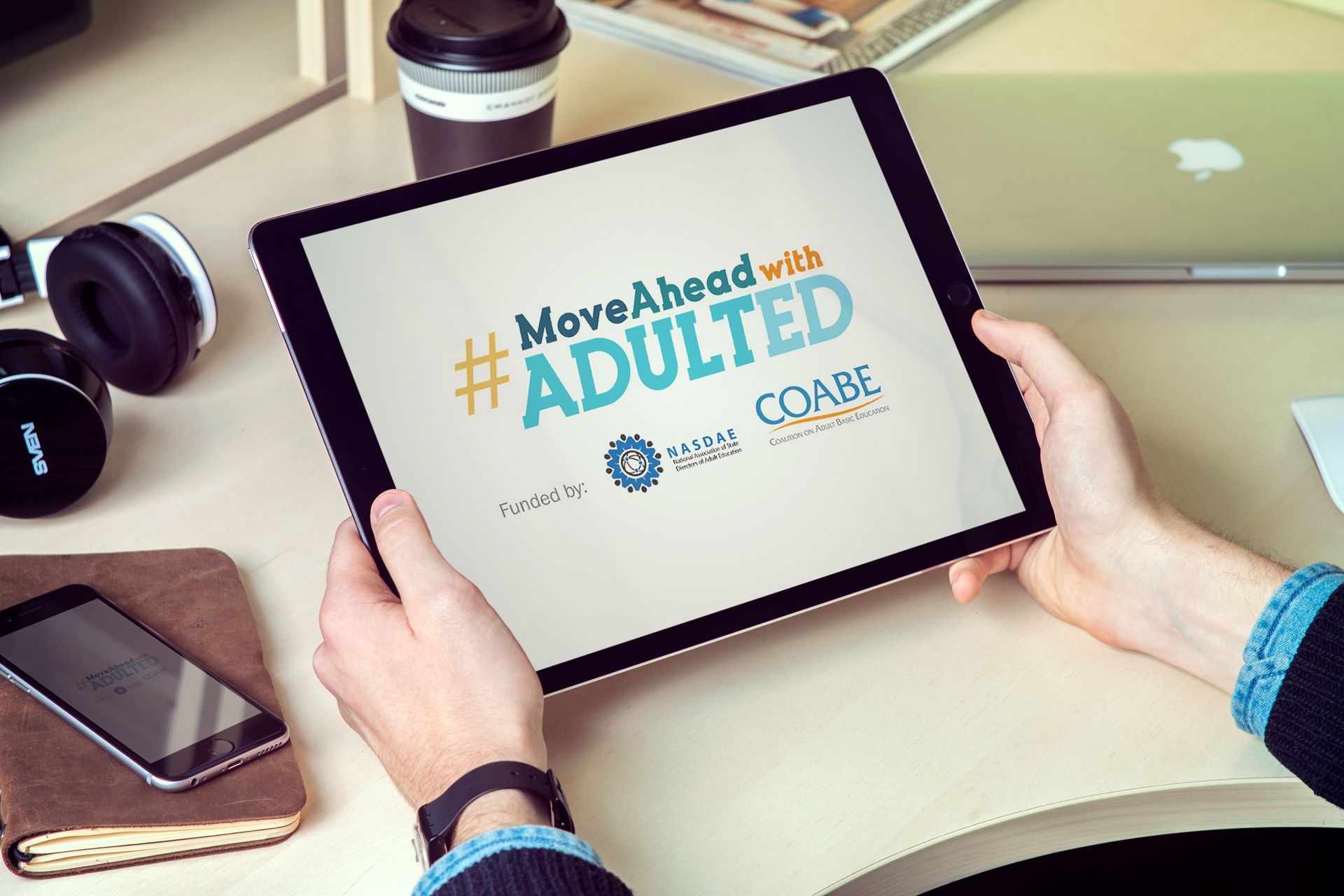
College enrollment nationwide dropped 30% during the fall of 2020, as they scrambled to take their courses online in response to the pandemic, according to the National Student Clearinghouse Research Center (NSCRC) annual report. Compared that to a 1% percent decline the year before. In response to COVID-19 and declining student enrollments, Full Capacity Marketing (FCM) partnered with the Coalition on Adult Basic Education (COABE) and the National Association of State Directors of Adult Education to create a national campaign called #MoveAheadWithAdultEd.
To jumpstart efforts in 2020, FCM developed a campaign toolkit that contained four essential communication tools to help adult educators with their student recruitment efforts; the campaign vision for 2021 is expanding.
2021 #MoveAheadWithAdultEd Campaign Vision
Adult education providers’ budgets fall woefully short in terms of the funding needed to recruit students and enroll them successfully. Additionally, they commonly use communication tactics that are often outdated and not effective in today’s pandemic environment, such as catalogs and mailers. Using automation, social media and lead capture forms could drastically expand reach to new potential students and increase enrollments.
COABE CEO Sharon Bonney explains that with limited funding and knowledge of how to effectively use digital mediums, it’s no wonder that adult education is the best-kept secret.
“Our vision for the 2021 #MoveAheadWithAdultEd campaign creates highly effective options for student recruitment campaigns with our marketing partner FCM,” Bonney said.
We’re teaming up to:
- Create a student-focused national campaign to elevate awareness about the value of adult education among prospective adult learners through a national web portal.
- Use digital advertising and public relations to increase enrollments in adult education offerings across the nation.
- Build the capacity of adult educators to effectively target prospective students likely to enroll within their service area.
The main page of the campaign portal will contain COABE’s zip code locator map to help students locate the nearest participating school. As an initial launch, FCM will create and maintain #MoveAheadWithAdultEd Facebook and Instagram pages to drive traffic to the locator map. These social media platforms also will support FCMin hosting digital ads and compelling content to build awareness about adult education programs.
“COABE has always been mission-focused to support adult educators through as many free resources and tools to build capacity in the field,” FCM CEO/Founder Celina Shands said. “While the campaign portal will help increase awareness among students, nationally, about their options, our agency can then run cost-effective local lead generation campaigns for schools that want a more tailored #MoveAheadWithAdultEd effort in their local area.”
For those schools that want to drive student leads to their local programs at 35-45% less than benchmark average costs, FCM creates a six-week lead generation campaign targeted to prospective students within their service area.
There are two options for local campaigns:
Option 1 is designed for a single school or regional clusters of schools (up to 5) that want to build a robust online presence to attract new students throughout the year. This option includes:
- A student recruitment #MoveAheadWithAdultEd campaign web page in the national portal, hosted by FCM for one year and branded with the school’s logo.
- Ads to promote adult education to prospective students in specific zip codes in the school’s service area.
- Six weeks of digital marketing, deploying ads through Facebook and Instagram.
- A student leads report delivered weekly.
- A social media toolkit to promote the campaign from the school/district social media pages.
- Entrance into the #MoveAheadWithAdultEd community, including a monthly e-newsletter that includes strategies to keep the campaign momentum, national best practices and access to FCM’s subject-matter experts.
Option 2 is designed for schools with an extremely limited budget and includes all of the items in Option 1, with the exception of the hosted webpage and entrance into the #MoveAheadWithAdultEd community of practice.
Bonney added, “FCM has been a great partner for our national advocacy efforts, helping us earn six international Davey Awards that resulted in $268 million in additional funding for adult education through the Educate & Elevate campaign launched in 2017. The new #MoveAheadWithAdultEd consumer-focused campaign will help schools with cutting-edge tactics that attract new students into adult ed, while elevating awareness at the national level.”
If you’d like to be added to COABE’s zip code locator map contact COABE. If you want to learn more about the options for a local campaign to drive enrollments to your school contact FCM.
Share this article

Does Your Organization Have an AI Mindset? One Workforce Executive Director Weighs In
For workforce development & education organizations, the rise of artificial intelligence poses a complex challenge: conflicting perspectives between employers who want AI-ready workers and job seekers who might be anxious about AI replacing them. Learn how one workforce executive director created an AI sector strategy.

From Digital Noise to Community Trust: How One Adult School Skyrocketed Net Fans by 3,950%
Social media provides organizations with a space to build trust and develop meaningful relationships with their audiences. By implementing an intentional social media strategy, South Bay Adult School successfully enhanced its outreach, resulting in increased post impressions, engagement, and more meaningful connections with students.

Mapping Content Topics for the Higher Education Recruitment Funnel
For today’s learners — especially adults balancing work, family, and a return to education — the path to enrollment is rarely linear. This blog details the specific content topics and formats needed to navigate today’s non-linear paths to enrollment.
Thought Leaders in Workforce, Education & Entrepreneurship
#MoveAheadWithAdultEd Celebrates 1 Year and Thousands of Adult Learner Leads
During the height of COVID-19, the Coalition on Adult Basic Education (COABE), the National Association of State Directors of Adult Education and Full Capacity Marketing partnered to develop a national campaign to address plummeting enrollments in adult education programs.
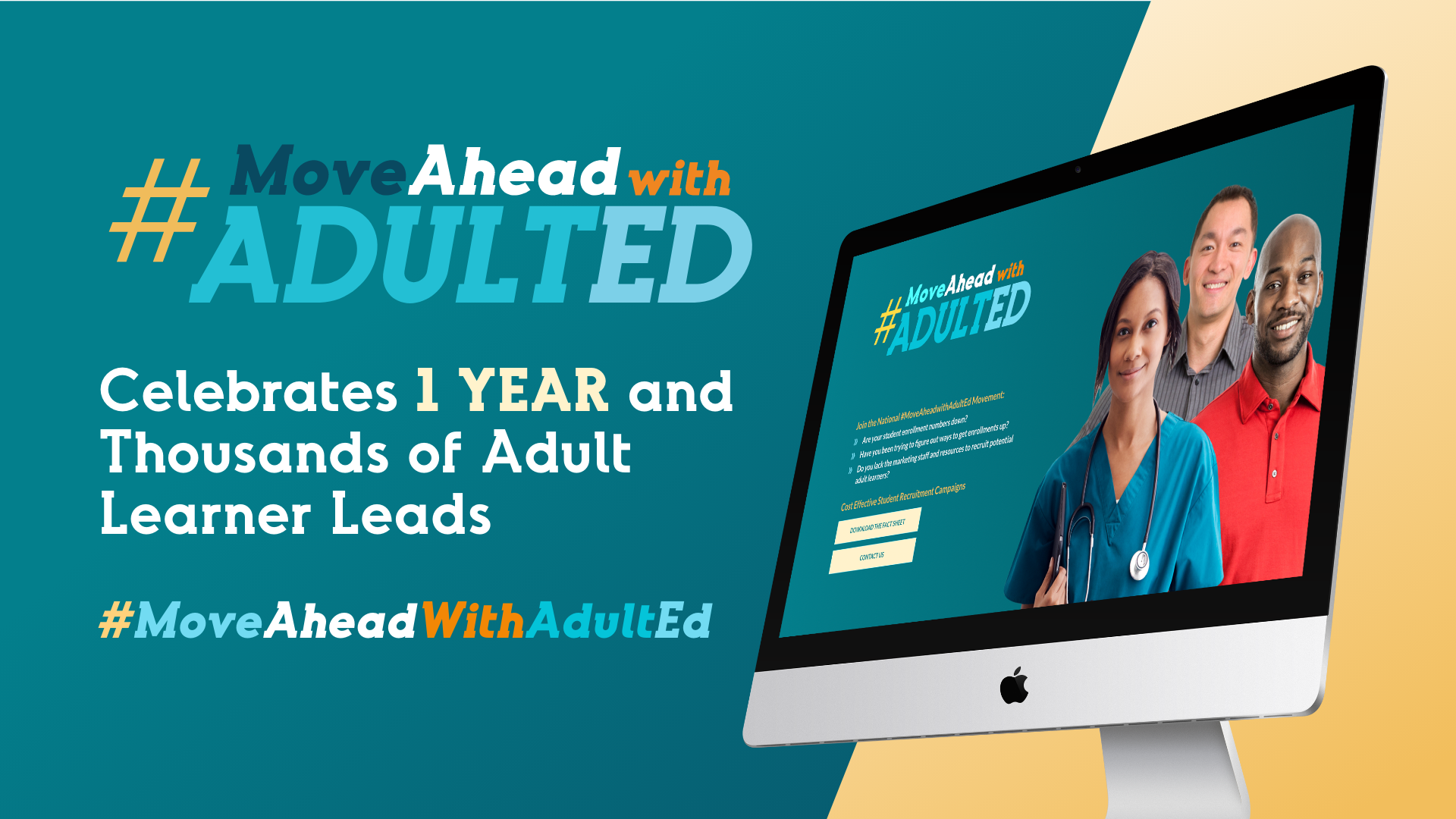
During the height of COVID-19, the Coalition on Adult Basic Education (COABE), the National Association of State Directors of Adult Education and Full Capacity Marketing partnered to develop a national campaign to address plummeting enrollments in adult education programs.
Fast forward a year, and #MoveAheadWithAdultEd has built awareness for over 5 million potential learners through national and local campaigns and resulted in more than 5,000 new adult learners added to the student pipelines of 12 adult education organizations. In addition, 2,300 participating schools nationwide have boosted their visibility via a school locator map on the campaign website and on their social media pages, using the campaign’s free student recruitment toolkit, and by using the #MoveAheadWithAdultEd tag.
To reduce substantial enrollment declines as a result of the pandemic, Full Capacity Marketing worked with COABE to offer schools and consortia the opportunity to leverage the national effort with local, paid digital adult learner recruitment lead generation campaigns in multiple languages. The campaigns have allowed FCM to create digital profiles of the various segments of adult learners and to gain valuable insights for effective demographic and behavioral targeting, messaging, creative and best practices on capturing underserved audiences who can benefit most from participation in adult education programs.
The effort is getting recognized! In the past year, #MoveAheadWithAdultEd has earned two global Davey Awards for integrated campaign, which included the student recruitment toolkit; the campaign website and the locator map. The partners used a digital campaign, covered by a $120,000 Google Ads scholarship, to drive prospective adult learners to the locator map.
If your organization serves adult learners and you want to list your services on the campaign locator map to receive free referrals, or if you want to run a localized lead-generation campaign with Full Capacity Marketing, go to https://moveaheadwithadulted.org/join-the-movement/. Adult learners interested in finding their local adult education programs can check out the campaign website at www.MoveAheadWithAdultEd.org.
Share this article

The Powerful Synergy Between Paid and Organic Social Media
Organic and paid social media are both powerful tools, each serving a distinctive purpose. At first glance, the distinction seems simple: organic is free, while paid is not. But the difference goes beyond cost– it’s about strategy, goals, and how audiences are reached. Organic social media refers to any content shared on a social media […]

Brand Videos: A Valuable Asset for Workforce & Education Organizations
Often short, well-produced, and designed to capture the attention of a target audience, a brand video is a marketing tool that promotes a brand, its products or services, or its values and mission. In today’s fast-paced digital landscape, many private sector companies use well-crafted brand videos to stand out from their competitors. But can this […]
Mapping Content Topics for the Higher Education Recruitment Funnel
For today’s learners — especially adults balancing work, family, and a return to education — the path to enrollment is rarely linear. This blog details the specific content topics and formats needed to navigate today’s non-linear paths to enrollment.
Thought Leaders in Workforce, Education & Entrepreneurship
LEADS LAB LAUNCHES TO HELP INCREASE WANING ENROLLMENTS
Your organization may be experiencing it first-hand, or you likely have seen the headlines about enrollment numbers in workforce and education trending downward substantially from previous years. While there a multitude of reasons affecting decisions of those contemplating the value of education and training, one constant remains—organizations still struggle with the sheer amount of follow-up […]
Your organization may be experiencing it first-hand, or you likely have seen the headlines about enrollment numbers in workforce and education trending downward substantially from previous years. While there a multitude of reasons affecting decisions of those contemplating the value of education and training, one constant remains—organizations still struggle with the sheer amount of follow-up needed to move a student/learner from an interested lead to an actual enrollment.
That’s why we recently launched the Leads Lab. The Leads Lab is a seamless process that uses targeted ad campaigns to generate student leads and then nurtures those leads through multiple touchpoints. We engage prospective learners through valued content designed to lead them down the path to booking a one-on-one appointment where they can ask questions about specific courses and start the enrollment process.
The Leads Lab helps clients hit the number of touchpoints needed to move a prospective student/learner to enrollment. While Google Think Tank reports it takes between 5 and 12 touchpoints to get a learner to enroll, most organizations don’t come close to this much interaction with a prospect. In fact, Invesp revealed that while 80% of efforts to close a prospect require a minimum of five follow-ups after the initial contact, 45% of outreach staff give up after only one follow-up.
Bandwidth issues, siloed recruitment approaches and failure to communicate a value proposition are just some of the issues that contribute to a lack of leads converting to enrollment. Through the Leads Lab, FCM does the heavy lifting in nurturing leads and getting appointments established on behalf of the workforce and education organizations we represent.
If you are finding it difficult to increase enrollments, contact us for a complimentary consult to evaluate your current enrollment processes and determine whether the Leads Lab is a good fit for your organization.
Share this article
Enrollment Digital Marketing Campaigns: A Guide to Campaign Metrics That Drive Enrollment Results
Enrollment Isn’t Just Marketing—It’s Mission Critical For higher education and workforce programs enrollment is more than filling seats. Every enrollment represents an opportunity to connect someone with education, skills development, career advancement, and long-term economic mobility. Today’s prospective students don’t simply respond to flyers or traditional advertising. They research programs online, compare opportunities, watch videos, […]
Using AI & Technology for Workforce & Education Marketing
While artificial intelligence (AI) has been viewed as a major disrupter by many, marketing is one of the areas where it is widely predicted that it will drive positive changes. In fact, a McKinsey study found that marketing is the single organizational function, along with sales, where AI will have the most financial impact. This means […]
The Powerful Synergy Between Paid and Organic Social Media
Organic and paid social media are both powerful tools, each serving a distinctive purpose. At first glance, the distinction seems simple: organic is free, while paid is not. But the difference goes beyond cost– it’s about strategy, goals, and how audiences are reached. Organic social media refers to any content shared on a social media […]
Thought Leaders in Workforce, Education & Entrepreneurship
Upgrading Your Website – Why You Shouldn’t Wait Another Day
After months of work to launch a new website, some organizations consider their website done. They may not be aware of the upkeep required to ensure their site is always operating at peak. It might be they don’t have the staff needed to keep up with site maintenance. Whatever the situation, research shows approximately 97% […]

After months of work to launch a new website, some organizations consider their website done. They may not be aware of the upkeep required to ensure their site is always operating at peak. It might be they don’t have the staff needed to keep up with site maintenance.
Whatever the situation, research shows approximately 97% of consumers base a portion of their purchasing decisions, in part, on an organization’s website. And if they have a bad online experience, 17% will leave after that one experience – 59% of consumers will abandon after multiple bad experiences, according to the PWC Future of Customer Experience Survey. For organizations operating in the workforce and education space, this could translate to fewer students, job seekers and employers enrolling in classes or signing up for your services.
The research indicates that both periodic investments in modernization and ongoing investments in upkeep are critical for organizations in every industry to maintain confidence in their customer base. If you haven’t spent time optimizing your website in the last couple of years, it’s along the lines of letting trash pile up outside the entrance to your business – not the look you want to present to your customers.
We know it’s hard to keep up. The digital world moves quickly and often. Over the past three years, there have been some dramatic shifts that affect non-upgraded websites.
- Google has drastically changed the way it indexes and ranks websites, with a greater focus on the mobile experience and performance. Websites that may have ranked highly before are being placed further down the search index because they have not upgraded to modern techniques that deliver an optimized consumer experience.
- Internet browsers have improved significantly, offering a wide array of new UI and UX tools to help create a highly engaging, visually compelling consumer experience. Modern browsers support a variety of native animation and engagement features – but websites must be upgraded to take advantage of these more sophisticated features.
- Content management systems have new offerings as well. WordPress, in particular, and other systems have introduced an entire suite of new capabilities. In fact, since early 2020, WordPress has released over 70 new features and tools that can be integrated to manage content more easily and present richer, more dynamic experiences to users.
Your website is one of the most powerful and effective ways of communicating with your customers, so it’s important that it deliver a smooth – and preferably, memorable – experience. That means regularly upgrading your site’s user interface (UI), user experience (UX), content management, and mobile performance.
Ask yourself:
- Could our site introduce interactive features that improve the customer experience?
- Does our site work well not only on a desktop computer but on mobile phones and other devices, too?
- Is there room to replace bland content with fresh, relevant content?
If you are not sure how to upgrade your site or improve the user experience, FCM can help. We keep our finger on the pulse of current and upcoming digital trends to facilitate exact upgrades, seamless transitions, and definitive understanding for our workforce and education customers.
Contact us today, and let’s talk about getting your website in optimal shape.
Share this article
Mapping Content Topics for the Higher Education Recruitment Funnel
For today’s learners — especially adults balancing work, family, and a return to education — the path to enrollment is rarely linear. This blog details the specific content topics and formats needed to navigate today’s non-linear paths to enrollment.

Getting Down to Business: Advocating for Small Businesses on Capitol Hill
FCM’s VP of Operations, Anika Jackson is a member of the Intuit Small Business Council which represents over 10 million small businesses. She recently had the privilege of participating in a visit to Capitol Hill to brief policy makers on the challenges facing small business owners and advocate for policies that support their growth and […]
Using AI & Technology for Workforce & Education Marketing
While artificial intelligence (AI) has been viewed as a major disrupter by many, marketing is one of the areas where it is widely predicted that it will drive positive changes. In fact, a McKinsey study found that marketing is the single organizational function, along with sales, where AI will have the most financial impact. This means […]
Thought Leaders in Workforce, Education & Entrepreneurship
Recruiting Students in an Ever-Changing Environment: How Personas Can Boost Engagement in a Post-Pandemic World
Discover how a well-executed education marketing campaign can boost enrollments and why personas are the key
For the past several years, secondary and higher education institutions have noticed a significant, worsening decrease in student enrollment. From four-year universities to community colleges and adult education programs, none have been exempted from the pervasive downward enrollment trend seen amid the COVID-19 pandemic.
To get enrollments back up, education programs are enlisting marketing companies to help them better understand their target markets, which includes getting into the psyches of prospective students. This understanding is the foundation of an effective recruitment campaign because when you know what motivates someone, you can ensure all your communications to that prospect, including ad campaigns, use words and a tone that most appeal to them. This important information about a target audience is rolled into what is called a persona.
Personas – Definition, Creation, and Execution
Personas are fictional characters that represent the target audiences your organization would like to reach. They are developed based on research about your target markets, and they emphasize a product or service’s benefits, versus its features. Lower in this blog article, for example, you will read about Spencer and Maria, whose stories were created based on research we conducted for an adult education campaign in Illinois.
Spencer and Maria’s stories, and those of other personas, are meant to appeal to the emotions of specific audience segments. Organizations typically will have more than one persona in their target market because motivators can be different for sub-segments within a larger audience segment. For example, an English language learner who wants to improve their English for work reasons will have different motivators (and barriers) than those who want to learn English to relate better to family members or help a child with homework.
Personas start with extensive demographic and psychographic information (Table 1) that allows you to get into the minds of audiences to create targeted emotional messages. Building out personas by audience segment will give you what you need to develop precise, strong messaging that resonates throughout an ad campaign.
Table 1: Examples of Demographic and Psychographic Questions
| Demographic | Psychographic |
| Do they own or rent a home? | What do they do in their free time? |
| Do they currently have a job or career? | What are their hobbies? |
| What is their highest level of educational attainment? | What websites, magazines, books, and movies do they gravitate toward? |
| Do they have children? | What are their goals, dreams and fears? |
A Real-World Application
Full Capacity Marketing is currently executing a statewide adult education campaign called Illinois Adult Education – Your Path. Your Future. to increase enrollments in adult education in that state. We evaluated the demographics and psychographics of students across the state to identify four market segments for the campaign, including adult learners who wanted to 1) learn English for career purposes; 2) learn English for personal reasons; 3) complete high school or prepare for college; and 4) prepare for a career.
Here are two different personas we used for the Your Path. Your Future. English language learner campaign:
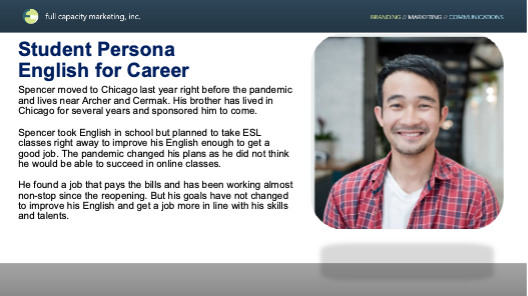
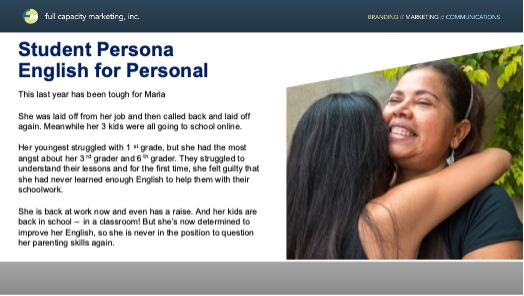
The personas capture the type of nuance that allows us to create tailored, emotional messages that relate to each segment’s behavior patterns, motivations, and goals, as reflected in the two ads below. This information is valuable not only for ad campaigns but for any communication that takes place with that specific audience segment. That could include email, text, social media posts or brochures.
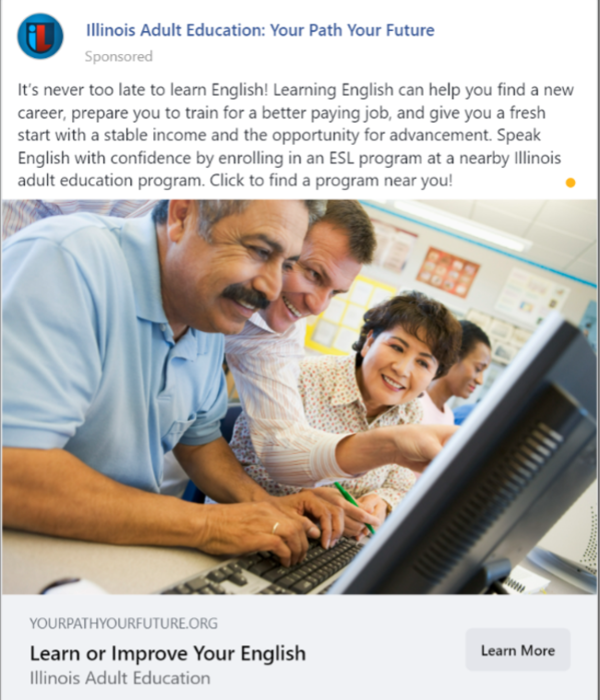
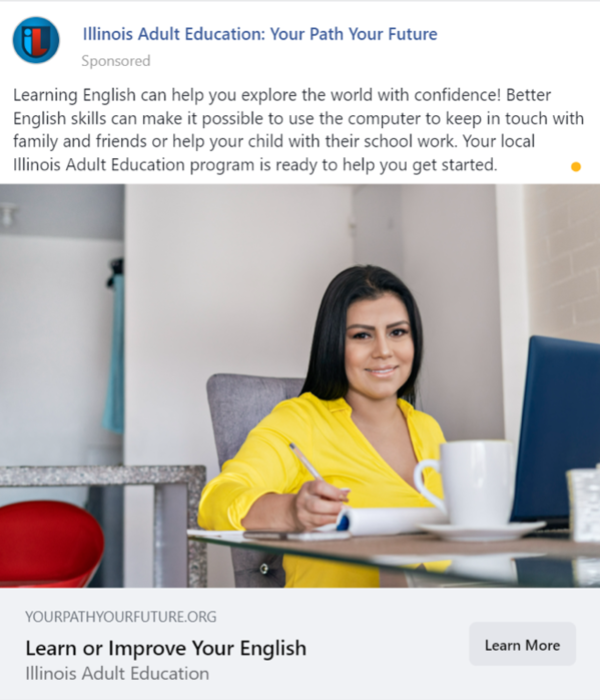
The segmented messages captured nearly 1,000 leads just a few months into the campaign. Some of the ads had click-through rates of over 5% (industry benchmark is .93%). This is because the more the message is tailored and targeted, the more interest it will generate.
The Approach to Maximize Success for Any Campaign
To summarize, here are the steps to create effective, emotional messages for your ad campaigns:
- Use demographic and psychographic data to understand the psyche of the market segment, including their fears and motivators.
- Create personas to represent students within your market segments.
- Use the personas to create effective messages for your various market segments.
Pro tip: Be sure your messaging includes your target audience’s pain points (key challenges they are currently facing within a post-pandemic environment); your solutions (programs and classes); a call to action (e.g., call your organization, enroll); and how taking that action will solve their pain points.
If you are thinking about an enrollment campaign for youth, jobseekers, students and/or adult learners, let’s work together. Contact us for a complimentary consultation.
Share this article
Brand Videos: A Valuable Asset for Workforce & Education Organizations
Often short, well-produced, and designed to capture the attention of a target audience, a brand video is a marketing tool that promotes a brand, its products or services, or its values and mission. In today’s fast-paced digital landscape, many private sector companies use well-crafted brand videos to stand out from their competitors. But can this […]
Capturing Hearts Through Visual Content: How Visual Storytelling Turns Interest into Action
Case Study – Discover the power of video storytelling in workforce and education marketing. When structured thoughtfully, video does more than showcase success, it builds emotional connection, reinforces credibility, and drives action.
Using AI & Technology for Workforce & Education Marketing
While artificial intelligence (AI) has been viewed as a major disrupter by many, marketing is one of the areas where it is widely predicted that it will drive positive changes. In fact, a McKinsey study found that marketing is the single organizational function, along with sales, where AI will have the most financial impact. This means […]
Thought Leaders in Workforce, Education & Entrepreneurship